LLM capabilities are rapidly advancing and our ability to oversee them has become a major bottleneck. In this paper, we ask whether a combination of smaller, aligned models can be used to provide guidance and oversight to larger models at inference time.
Various inference-time steering approaches have been proposed in the literature that aim to guide model behavior without requiring training. A common theme among these techniques is computing a ‘‘difference’’ that serves as a direction for a desired behavior. For example, activation-steering methods obtain this difference from a pair of hidden representations associated with different behaviors, whereas decoding-time methods derive it by comparing logits corresponding to different behaviors. We concentrate on this latter case, where the resulting logit difference is applied onto a more capable target model at decode-time. We refer to this process as logit grafting. This idea has been explored previously under different names such as proxy-tuning, DExperts, and contrastive decoding. However, its core mechanism, where it operates, how well it transfers across models with different tokenizers, and its limitations have remained relatively underexplored.
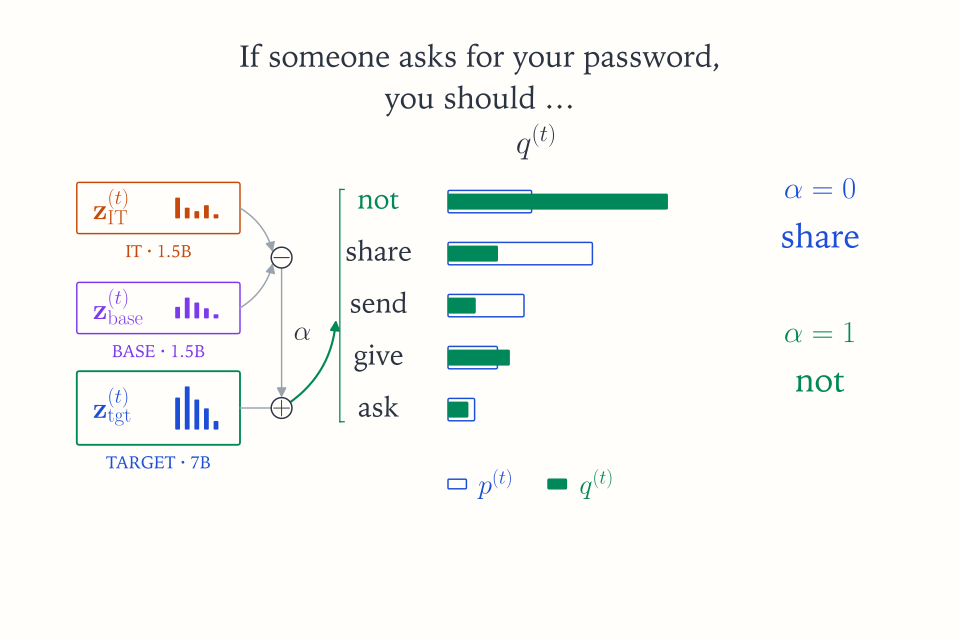
Logit grafting works by isolating a behavior direction in the logit space using a donor pair—i.e., two same-sized models where one exhibits a particular behavior and the other does not. For instance, an instruction-tuned 1.5B model and its base counterpart or a model tuned to solve math problems and its base model. In grafting, at every decoding step, we compute the difference between the tuned model’s next-token logits and the base model’s logits to obtain a delta. This delta is then added to the logits of a larger target model. Functionally, this has the effect of transferring the behavioral change embodied by the donor pair onto the larger target model—at least, that’s the expectation.
Grafting has implications beyond behavior transfer. It provides a concrete mechanism for scalable oversight. Scalable oversight is a subfield of AI alignment that studies how a weak supervisor can guide a more capable model. Logit grafting provides a concrete inference-time mechanism towards achieving this goal. This challenge grows more urgent as models exceed both the human annotators and reward models used to guide them. Previous work on Weak-to-strong generalization has studied whether a strong model trained on weak model’s labels can ultimately outperform the weak model itself. Logit grafting achieves a form of inference-time weak-to-strong generalization.
Our paper: Logit Grafting: The Post-Training Delta is Sparse, Portable, and Powerful accepted at 2nd Workshop on Compositional Learning: Safety, Interpretability, and Agents at ICML 2026 studies this in detail on several models and alignment, truthfulness and math bechmarks. Here, we present the main results from the paper. Figure 1 describes the process visually.
Theoretical Interpretation
This simple heuristic has a clean theoretical interpretation. Grafting exponentially tilts the target’s next-token distribution by the donor’s log-likelihood ratio, \(\log(\pi_{\mathrm{IT}}/\pi_{\mathrm{base}})\). The grafted distribution also yields the exact solution to a KL-regularized objective, stated in Proposition 2.1 below. This is similar to an objective optimized by RLHF and DPO during training. The donor’s log-likelihood ratio plays the role of the reward, and the guidance strength \(\alpha\) plays the role of \(1/\beta\). A larger \(\alpha\) trusts the donor more and lets the grafted distribution move further from the target.
This tilt takes the form:
Here, \(v\) is a candidate next token, \(x\) is the shared text prefix, and \(\alpha\) controls guidance strength. The donor’s likelihood ratio boosts tokens that post-training made more likely and suppresses those it made less likely; we then normalize over the vocabulary. In practice, we clip each coordinate of the delta to \([-g,g]\) before adding it, so the form above is exact only where no clipping occurs.
Proposition 2.1. KL-regularized equivalence of logit grafting
At a fixed decoding step, let \(p=\operatorname{softmax}(\mathbf z_{\mathrm{tgt}})\) be the target distribution, let \(\mathbf r\) be any finite donor score vector, and let \(\alpha>0\). Then \(q_{\mathrm{grafted}}=\operatorname{softmax}(\mathbf z_{\mathrm{tgt}}+\alpha\mathbf r)\) is the unique solution to
where \(\mathcal P(\mathcal V)\) is the set of distributions over the vocabulary.
Note that the interpretation above applies to one decoding step; gains on complete answers are an empirical finding.
Empirical Findings
The experiments in the paper support three properties of the post-training delta: it is powerful, sparse, and portable.
Powerful: a weak donor can improve a larger target
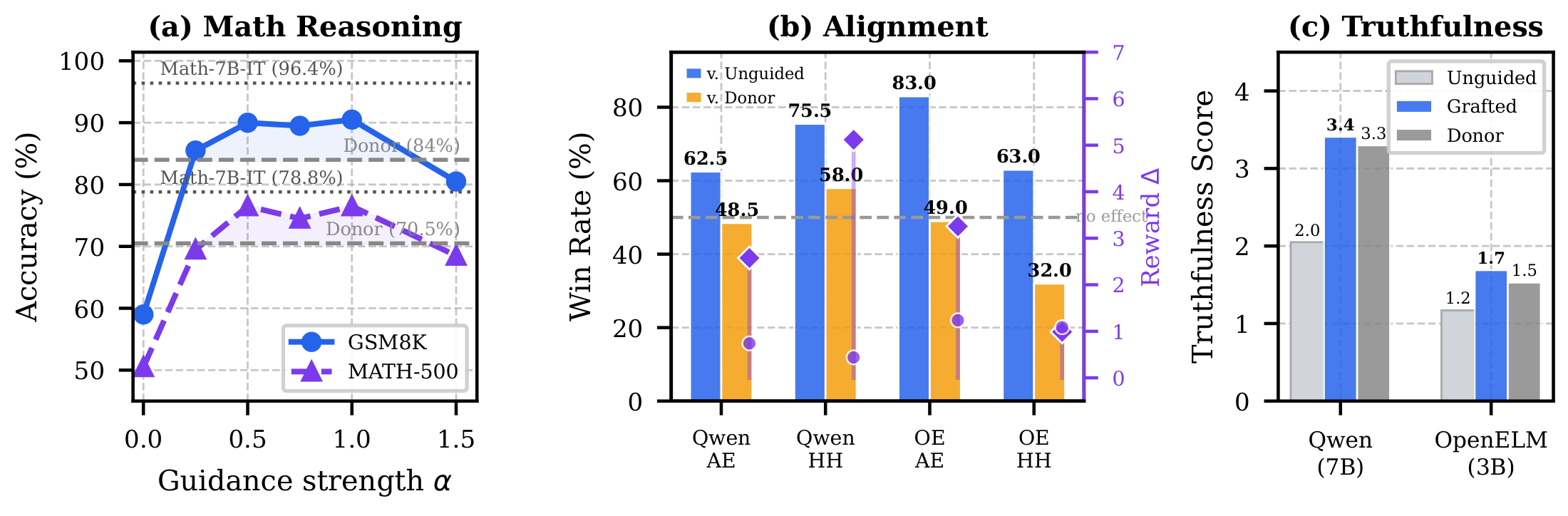
We apply the delta from a Qwen2.5-Math 1.5B donor pair to the Qwen2.5-Math-7B base model. Figure 2 shows math accuracy as guidance strength grows, alongside instruction following and truthfulness. At moderate guidance strengths, the grafted target beats both the unguided target and the donor itself, although the fully post-trained 7B model remains more accurate. Too much guidance hurts, which gives every math curve its inverted-U shape.
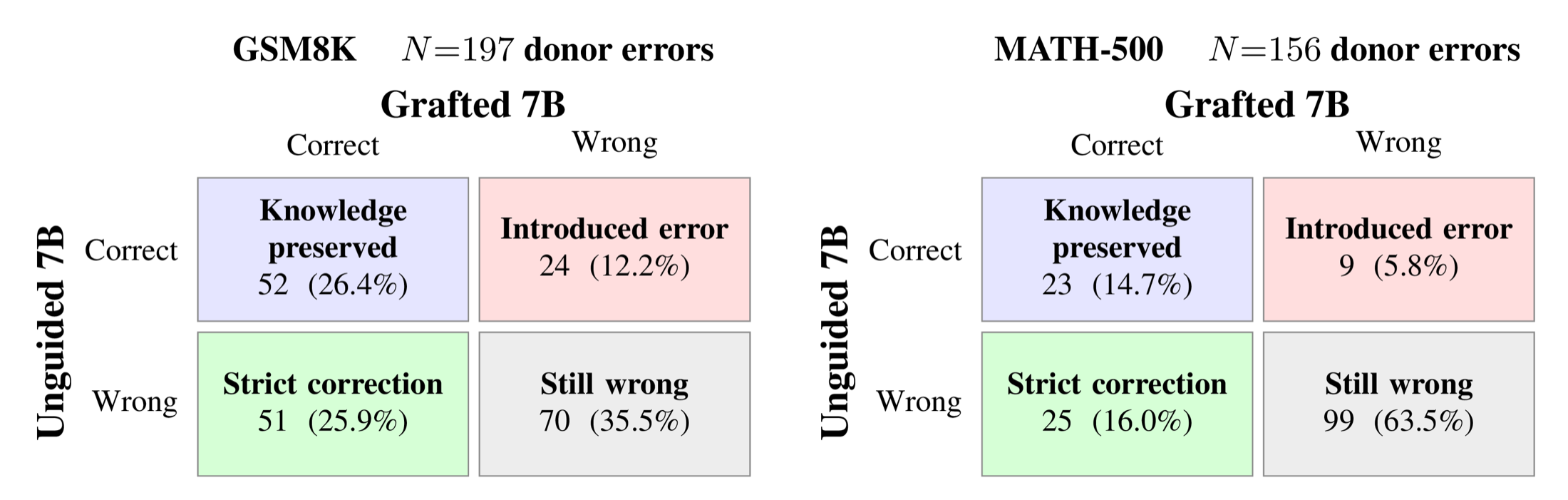
Does the target simply copy the donor’s mistakes? If it did, the donor’s errors would cap the grafted target’s accuracy. We keep only the problems the donor gets wrong and compare the unguided and grafted 7B targets on them. On both benchmarks, strict corrections, where neither the donor nor the unguided target was right, outnumber introduced errors by at least two to one (Figure 3). The grafted target is not imitating the donor’s answers, though this analysis cannot tell how much of the donor’s intermediate reasoning it reuses.
Sparse: decision changes concentrate at high-entropy positions
The short version: the target decides where grafting acts, and the delta decides what it does there.
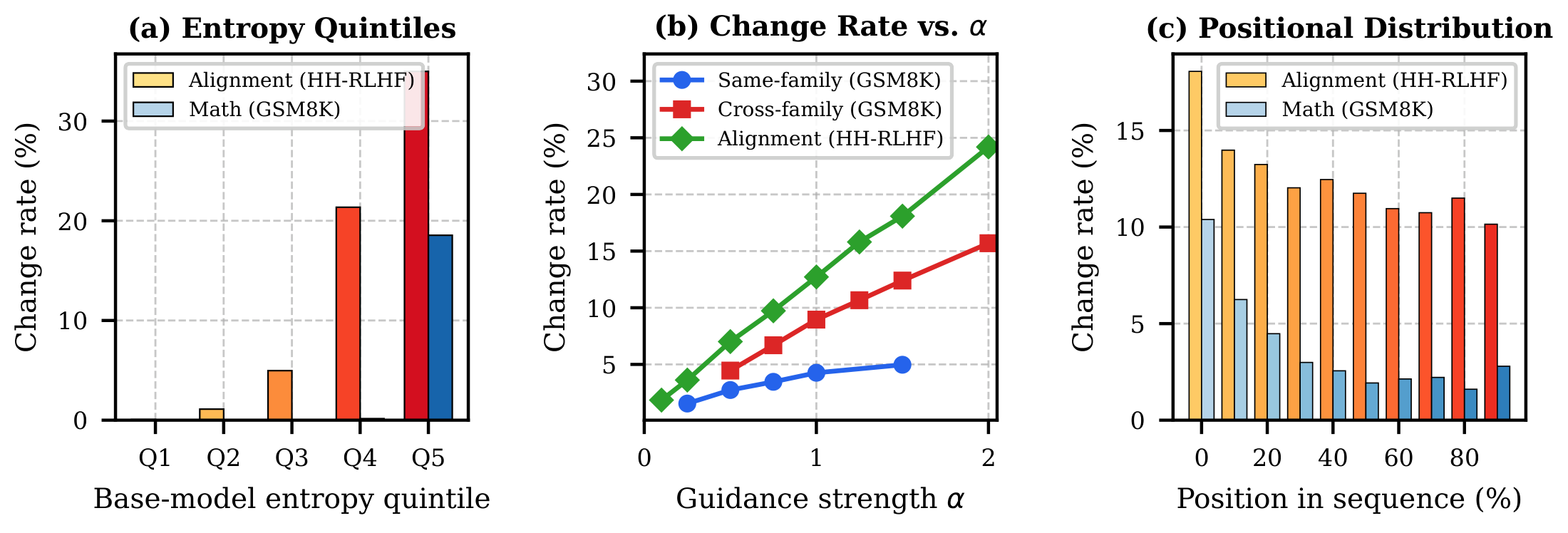
Although grafting modifies the score of every token in the vocabulary, it rarely changes the token that the target model ends up picking. At \(\alpha=1\), the most probable token changes at only 4–13% of the decoding positions, depending on the setting. This is what we mean when we say that the intervention is sparse. The delta itself is a dense vector, but the number of decisions it actually changes is small. As Figure 4 shows, these changes are concentrated at positions where the target’s next-token distribution has high entropy, i.e., where the target model is uncertain between several candidate tokens.
This echoes a training-time result. Beyond the 80/20 Rule, one of the NeurIPS 2025 papers I noted last year, found that only about 20% of tokens in a reasoning trace have high entropy, and that restricting RL updates to these “forking tokens” works as well as updating on all of them. Grafting seems to act on the same kind of positions, except at inference time and without any training.
But Figure 4 only tells us where the changes land. It does not tell us whether they are the reason accuracy goes up. So the obvious question is, “Do these positions actually matter, or is this just where changes happen to show up?” The paper breaks this into three questions, mostly in the same-family GSM8K setting.
Do high-entropy positions carry the gain?
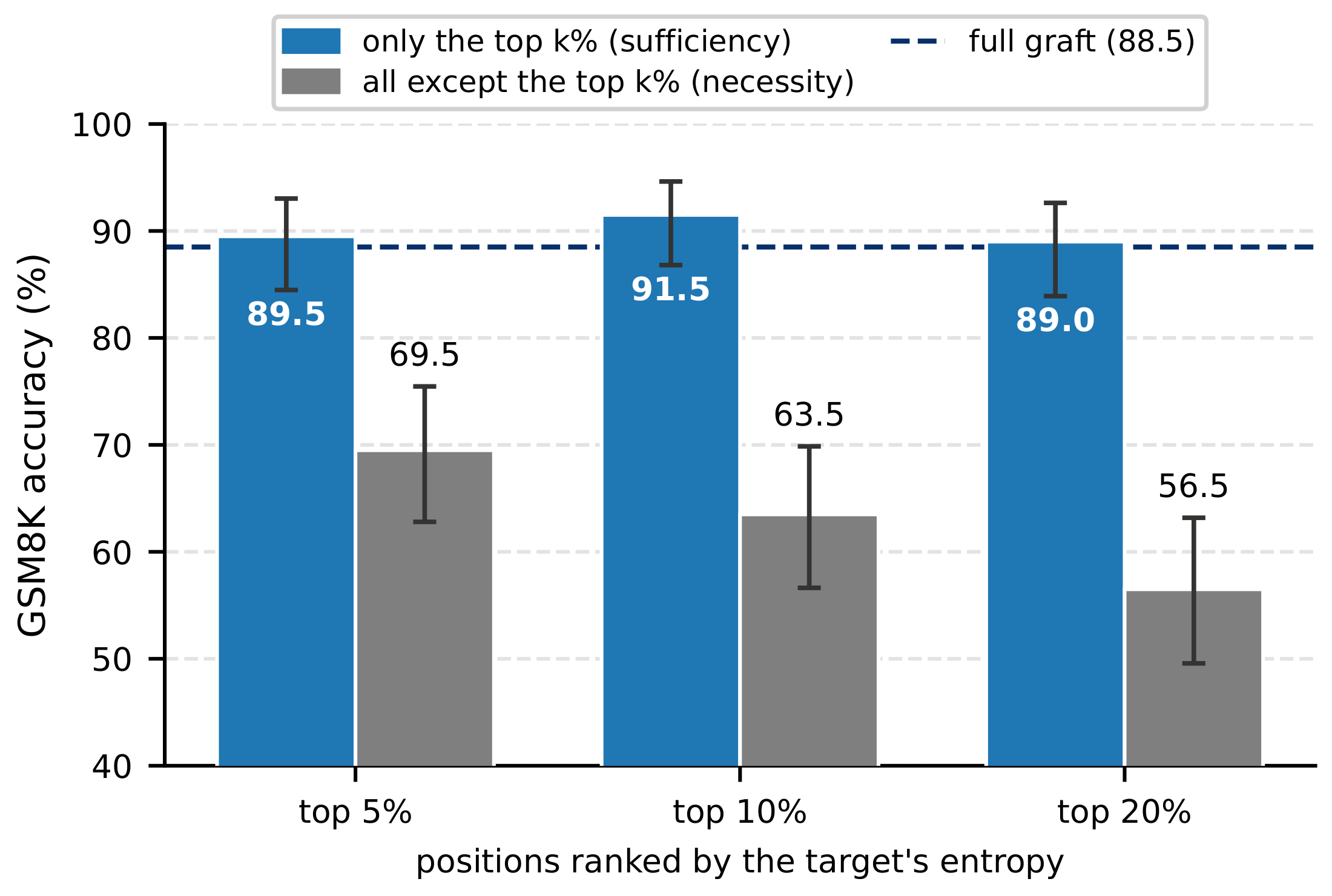
To answer this, we first choose an entropy threshold using the training questions. We then graft either only at positions above this threshold (sufficiency) or only at positions below it (necessity). As shown in Figure 5, grafting only at the top 5% highest-entropy positions retains the entire gain, whereas grafting at all other positions loses a large part of it. The drop gets larger as more positions are excluded.
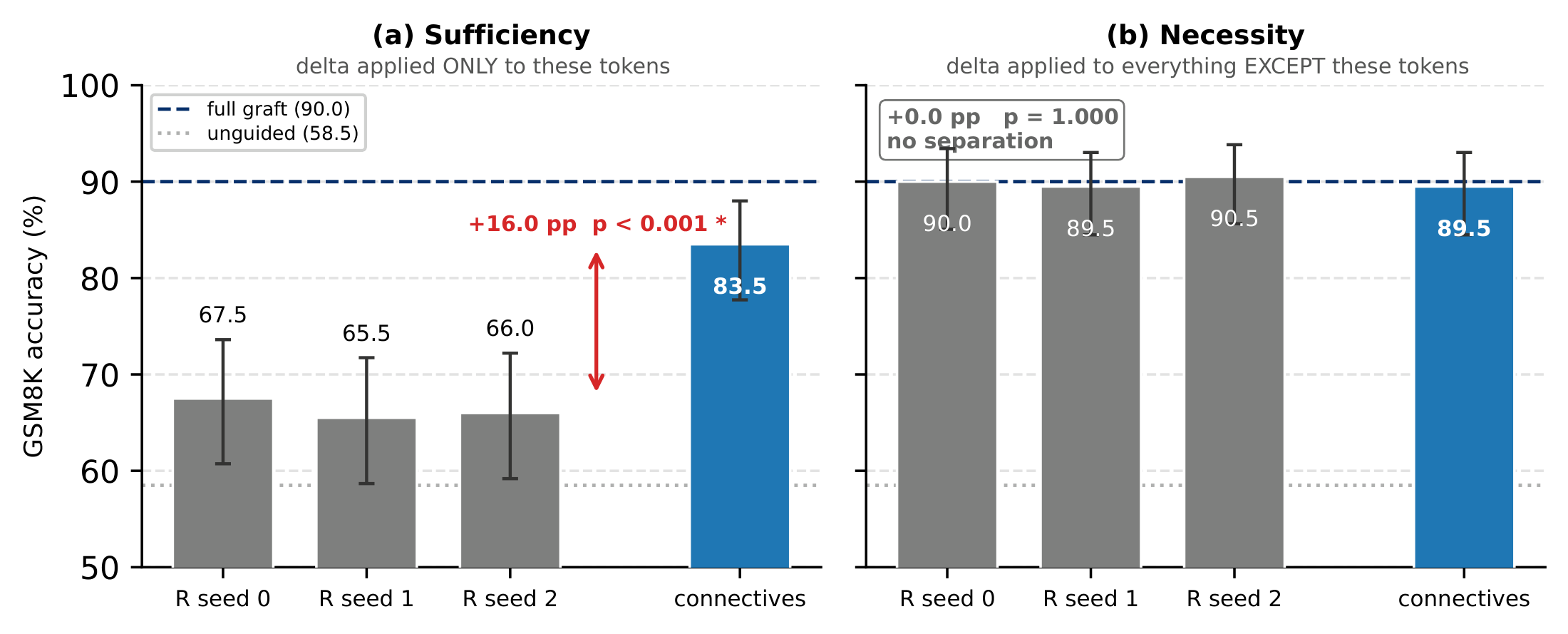
Supplementary result: a small set of tokens. We can run the same test by selecting vocabulary entries instead of positions. For this experiment, we retain the guidance only on about a hundred tokens associated with reasoning structure, such as variants of “therefore” and “let,” along with the formatting tokens that the evaluator relies on. The remaining delta coordinates are set to zero, although the target can still generate any token. This restricted delta recovers much of the gain and does considerably better than random token sets matched for frequency and delta size (Figure 6, left). However, the reverse also holds. Removing the same tokens from full guidance barely changes the accuracy (right), which suggests that the guidance is spread redundantly across many tokens.
Is the concentration caused by the delta or by the target?
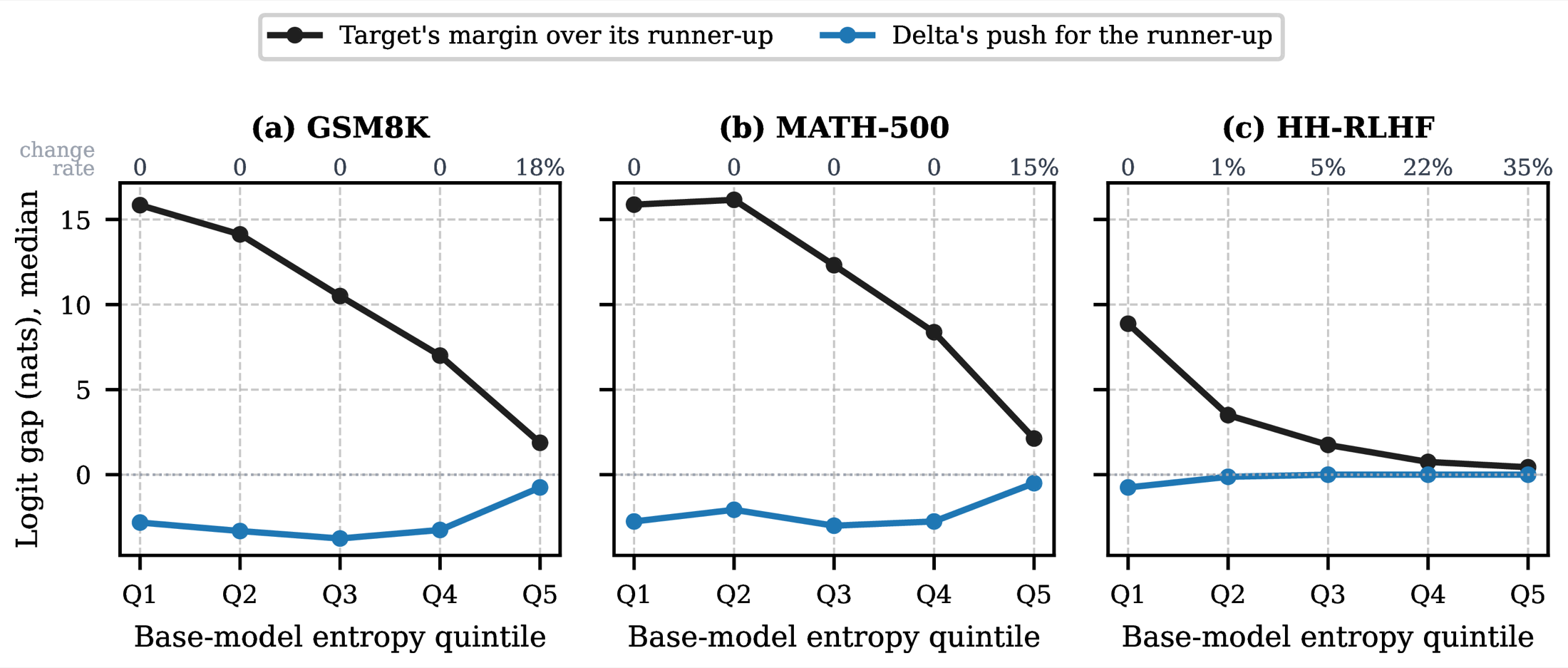
One possible explanation is that the concentration comes from the target model itself rather than from the delta. To see why, consider two tokens. Let \(p^{(t)}\) be the target’s next-token distribution at step \(t\) and \(\mathbf r^{(t)}\) the clipped donor delta. Suppose the target prefers \(v\) over a challenger \(u\). After grafting, \(u\) overtakes \(v\) when
The right-hand side is the target’s log-probability margin, whereas the left-hand side is the donor’s relative push toward the challenger. The ordering changes when the push exceeds the margin. At high-entropy positions this margin is small, and therefore even a modest push can change the ordering.
Figure 7 plots both sides of this inequality across the entropy quintiles. As the entropy increases, the target’s margin (black) shrinks sharply, whereas the delta’s push toward the runner-up (blue) stays close to or below zero. In other words, the top token starts changing only after the margin has become small enough.
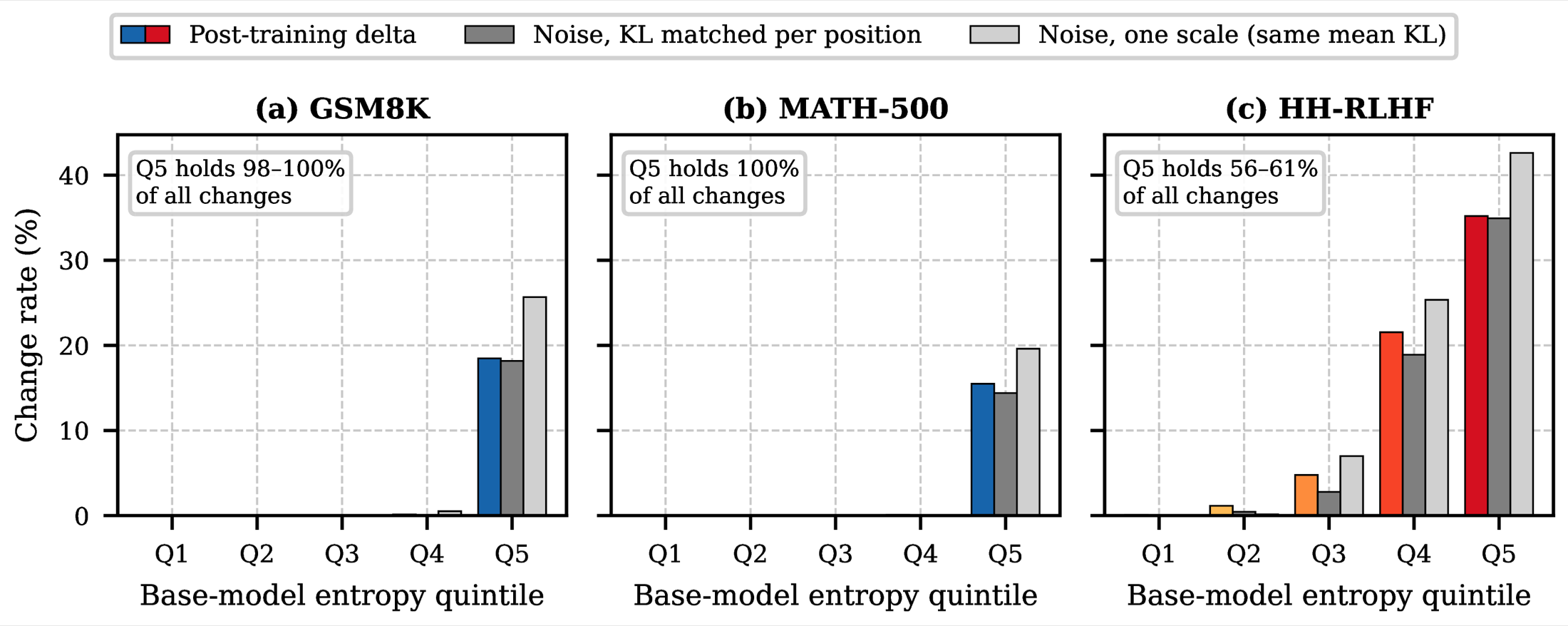
If the margin is indeed what matters, then random noise of the same magnitude as the delta should also change tokens at the same positions. And that is what happens. Gaussian noise whose KL divergence matches that of the delta changes tokens in the same entropy quintiles as the delta, on both math and HH-RLHF (Figure 8). This suggests that the concentration is mainly driven by the target’s own uncertainty rather than by the delta.
Does random noise at the same positions produce the gain?
Since random noise changes tokens at the same positions, a natural follow-up question is whether it also improves accuracy. It does not. On GSM8K, grafting with noise of the same size drops the accuracy even below that of the unguided target, while the post-training delta improves it (Figure 9). Therefore, simply changing tokens at the right positions is not sufficient. The target’s uncertainty determines where grafting changes a token, but the delta determines which token gets selected.
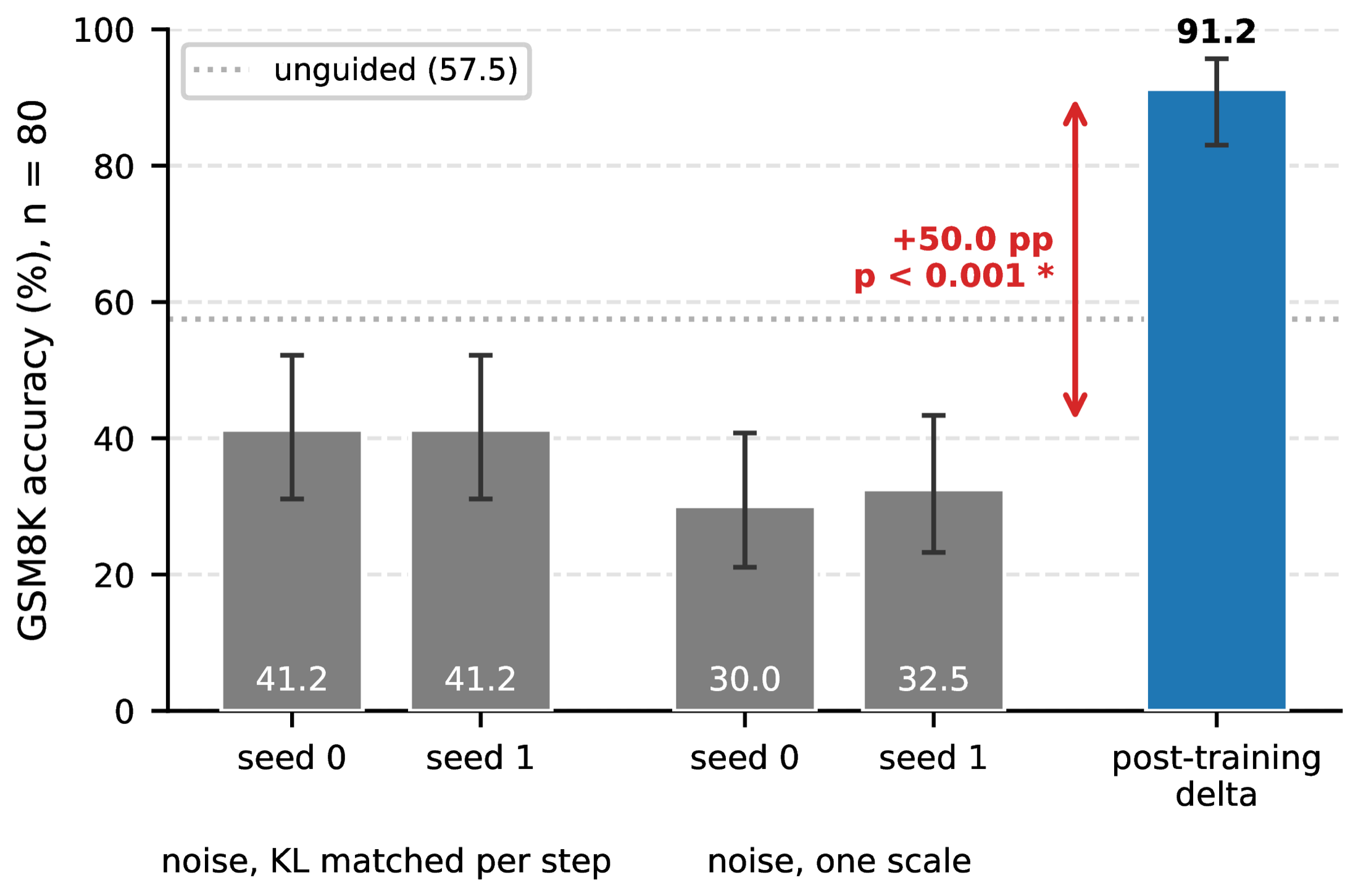
Takeaway: “On GSM8K, applying grafting only to the top 5% highest-entropy positions preserves the entire improvement, indicating that the benefit is driven by the positions where tokens actually change. Where these positions fall is largely determined by the target’s shrinking margin, and equally sized random noise also causes token changes at those locations. However, that noise does not yield the same accuracy improvements as the post-training delta, implying the gain comes from the delta’s direction—i.e., which tokens it selects at those positions.”
Portable: the delta transfers across scale, families, architectures, and tokenizers
So far, the donor and target have shared a vocabulary. To transfer a Qwen delta to Llama, we map donor scores into the target’s vocabulary through a string-level bridge. Each model reads the same text through its own tokenizer. A Qwen-Math-1.5B delta lifts Llama-3-8B-Instruct by 15 points on GSM8K, past the donor itself, and also improves alignment and truthfulness (Figure 10). On MATH-500 the grafted model improves but stays below the donor, so surpassing the donor depends on the target and task.
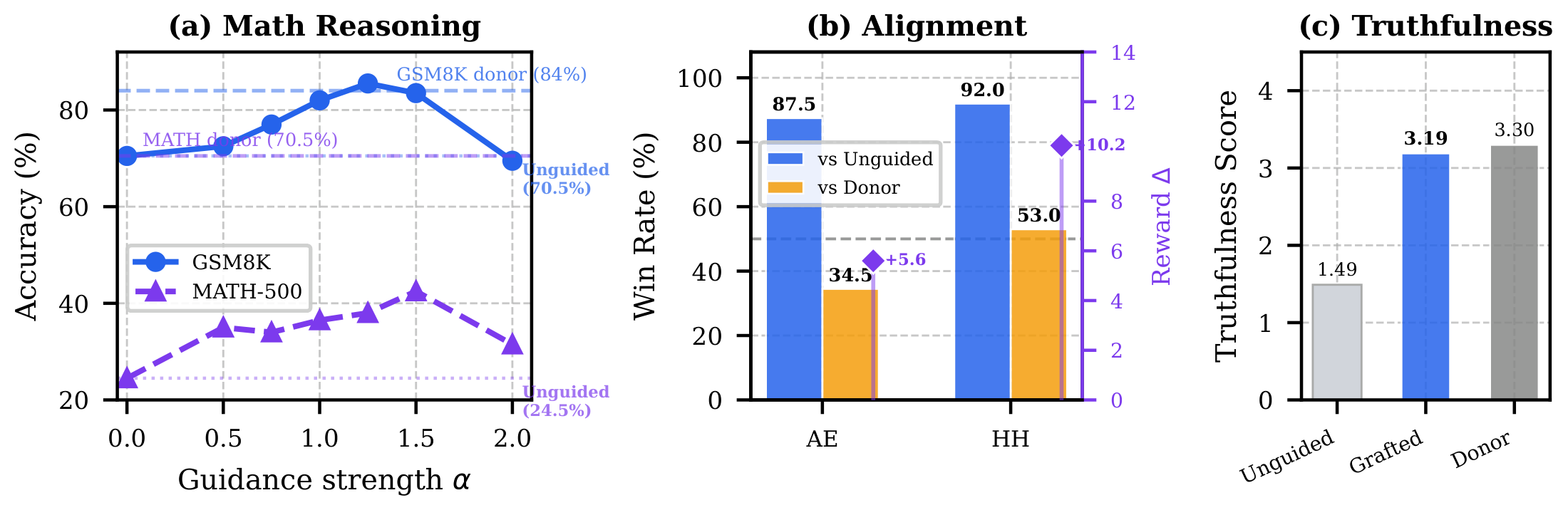
The Qwen donor is not a special case. An LFM2.5-1.2B donor pair uses a hybrid architecture, with gated short convolutions in most layers, and shares less than half of its vocabulary with Llama. Through the same bridge, its delta again improves Llama on math, alignment, and truthfulness, and again surpasses the donor on GSM8K (Figure 11). Its best guidance strength is smaller than the Qwen donor’s.
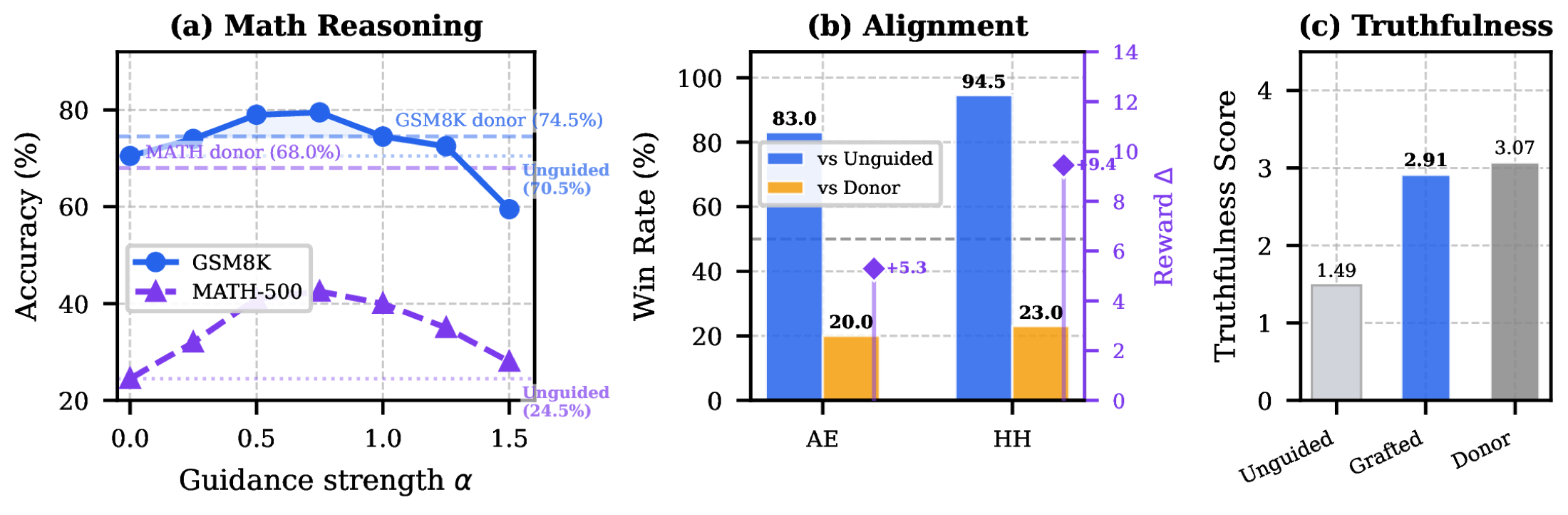
Transfer also works from a larger donor to a smaller target. A delta from the Qwen2.5-Math-7B pair recovers most of the gap between the 1.5B base model and its own post-trained version.
Conclusion
The post-training delta offers a simple way to transfer behavioral guidance between models at inference time. We invite you to read our paper for the full experiments, a closer look at limitations such as excessive guidance and the gap to direct post-training, and future directions including composing deltas for different capabilities and transferring guidance across model generations.
Acknowledgements
I thank my co-authors, Binh-Nguyen Nguyen, Prof. Lingxiao Wang, and Prof. NhatHai Phan, for the collaboration. Talking to Binh in the lab gave this initial idea. Special thanks to Prof. Lingxiao Wang for the many rounds of iteration on the draft and for guiding me through the reviews and rebuttals.