Despite numerous advances, hallucinations continue to plague LLM generated text. As a result, legal citation hallucinations have found their way into legal documents such as briefs, filings and even published opinions. Exactly why LLMs hallucinate at all is a subject for another post1. Theoretical results point to the impossibility of eliminating hallucinations completely in pretrained LLMs. In the meantime, however, various post-hoc measures such as post-training and guardrails, all active research areas, have been adopted to contain the harm.
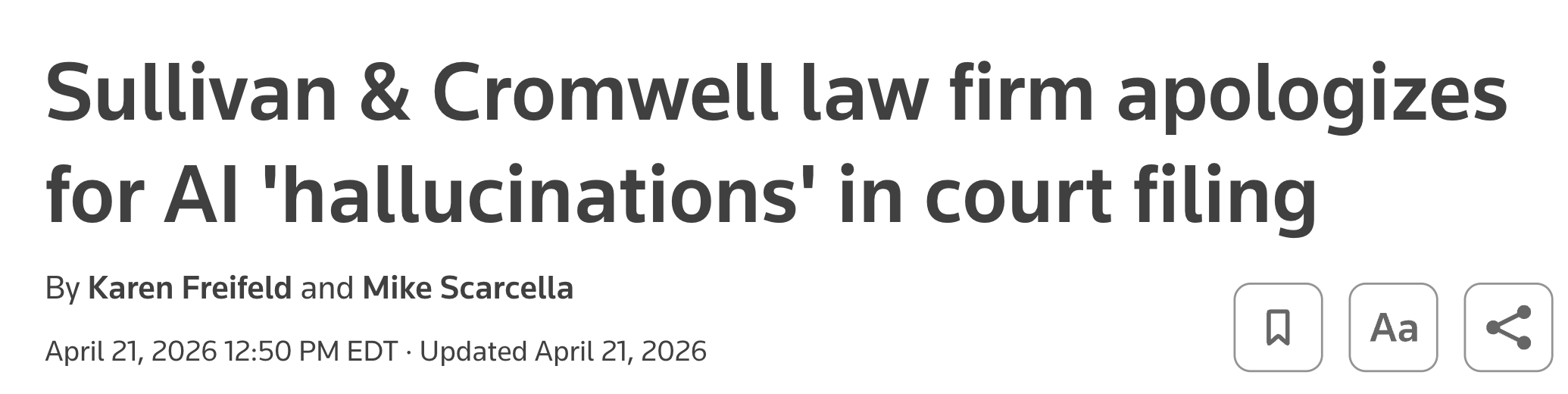
That is the problem my recent paper, “Is this Citation on Point?” studies. The paper was presented by Parisa Kordjamshidi, who kindly agreed to present it on my behalf, at the 1st AI for Law Workshop at ICML 2026. Discussion of the problem hasn’t just stayed within academic circles. News coverage of these failures has become routine.
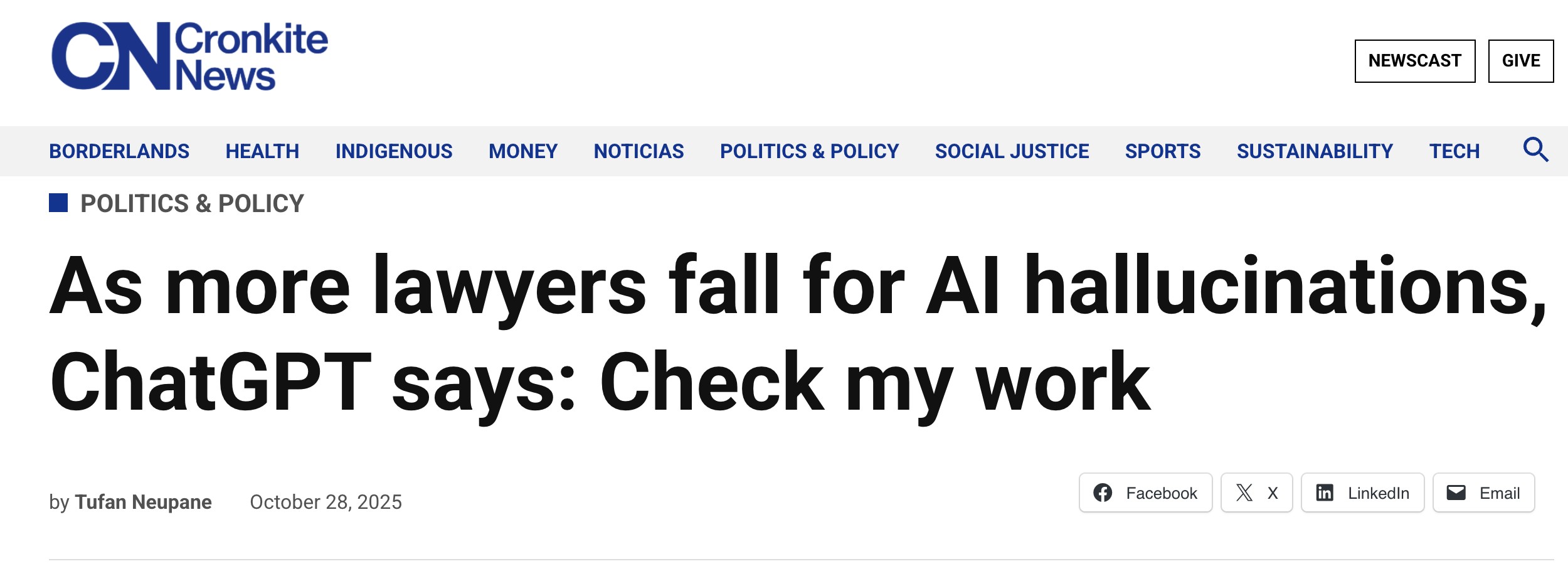
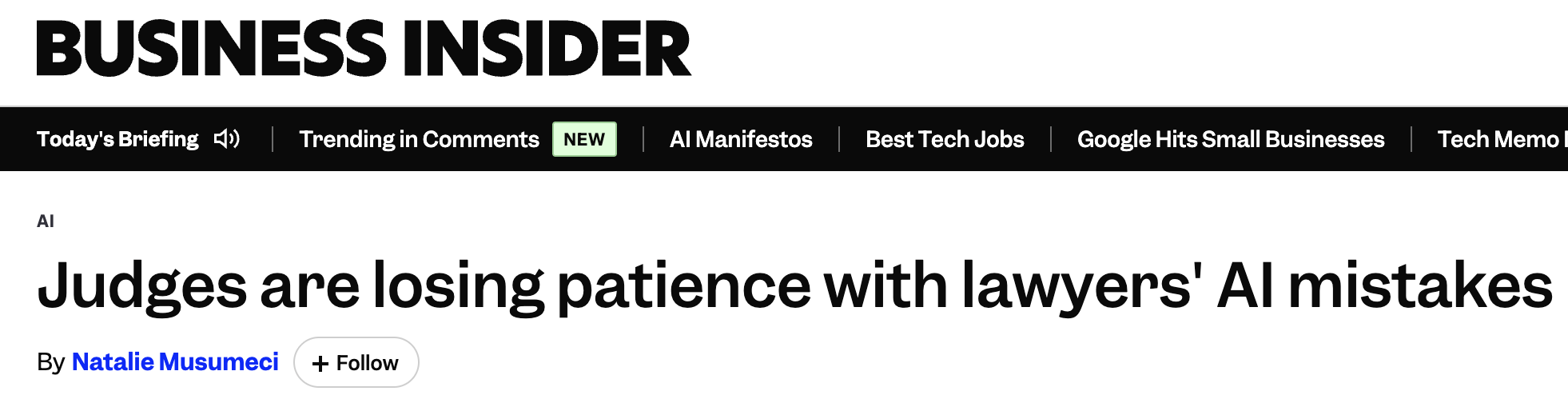
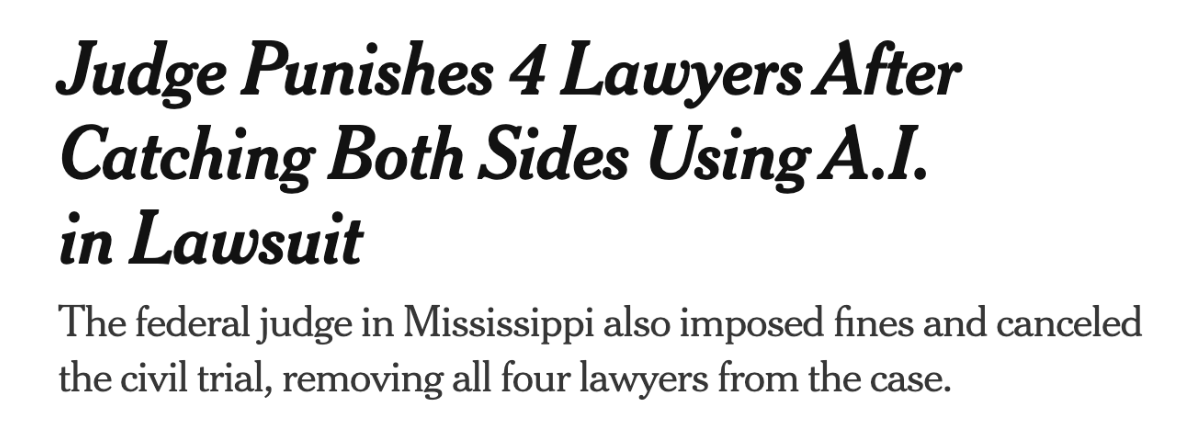
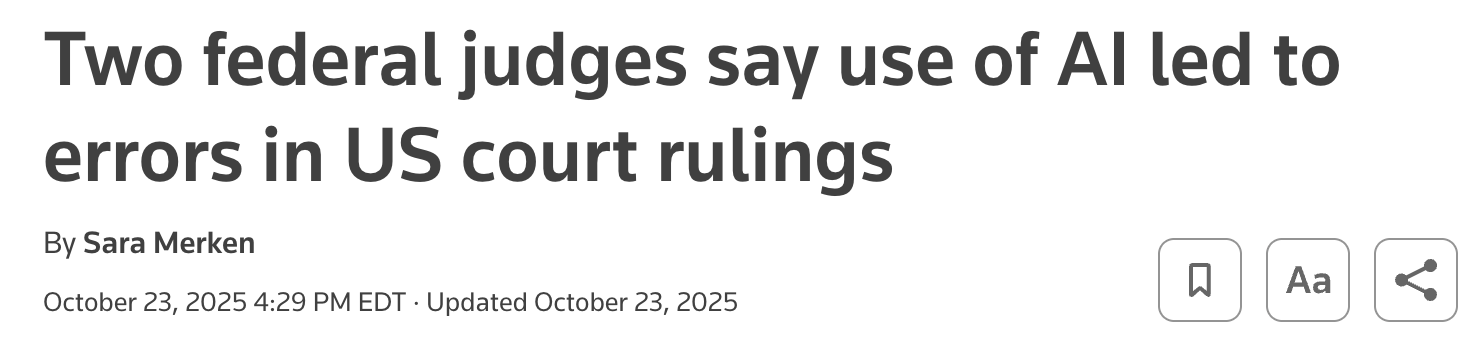
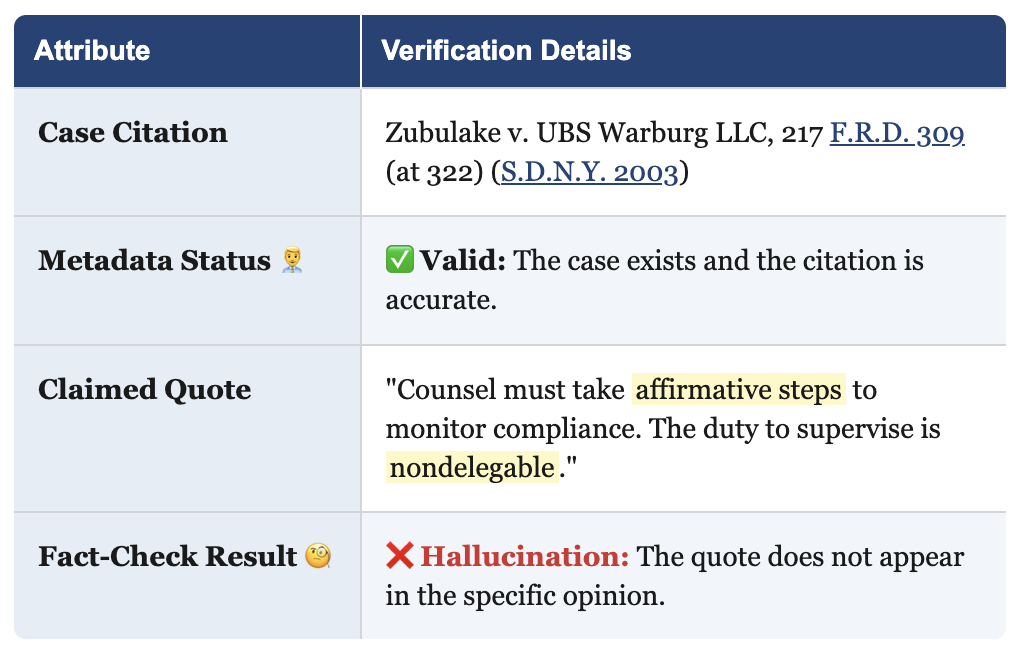
Citation hallucinations can be broadly classified into two main categories: fabrications and misrepresentations. A fabricated citation is one that does not exist at all. There is no real court opinion, statute or regulation corresponding to that citation. It is completely made up. A misrepresented citation, on the other hand, is one that exists but does not support the proposition for which it is being cited. All underlying elements of the citation are valid2, but the cited authority does not actually support the claim being made. While a simple database lookup may suffice for detecting fabricated citations, misrepresented citations are more subtle and harder to detect.
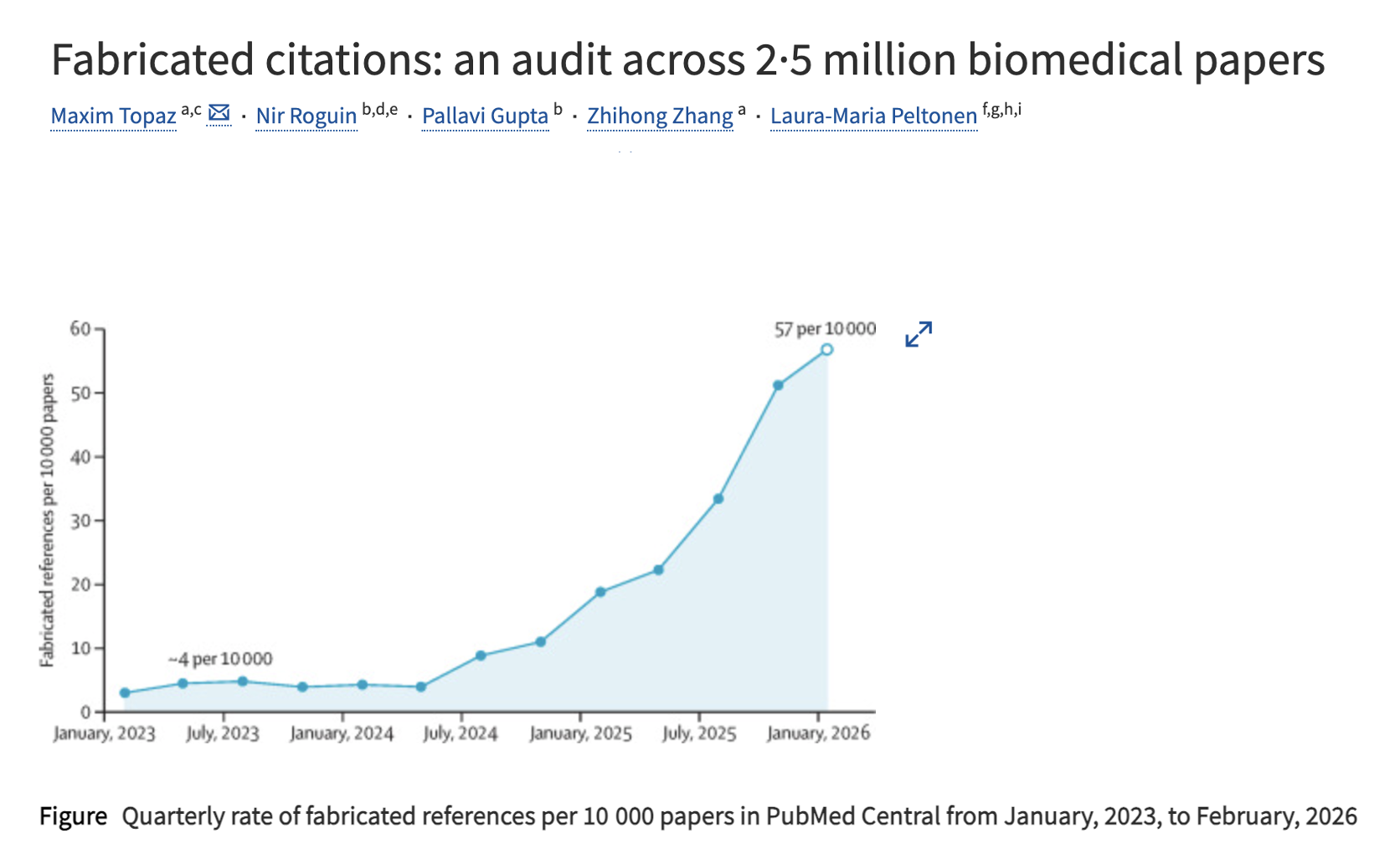
And the problem isn’t limited to the legal domain. Other academic fields such as biomedical research have also seen a steep rise in fabricated citations.
As tools evolve that can detect fabricated citations better, misrepresented citations become more, not less, important.
The Task
This brings us to the task we study in our paper. Our paper focuses on misrepresented citations. We ask whether commercial LLMs can serve as effective guardrails in detecting these misrepresentations. We refer to this task as legal citation support verification. Normally a citation’s purpose is to provide authority for a proposition; however, legal citations may also serve some auxiliary functions such as providing context, background, and procedural history. We focus on substantive case-law citations, not on procedural or background citations as these are the citations that the source passage carries discussion about.
We rely on two existing legal corpora for the on-point examples: CLERC and BriefMe. CLERC contains court opinions, and BriefMe contains legal briefs. We then create controlled citation corruptions for the not-on-point examples. We do not claim that the corruption techniques we employ result in accurate reflections of real-world citation hallucinations. The point is to measure whether the model can verify support in these kinds of contrived mismatched settings. We create three levels of difficulty: Easy, Medium, and Hard.
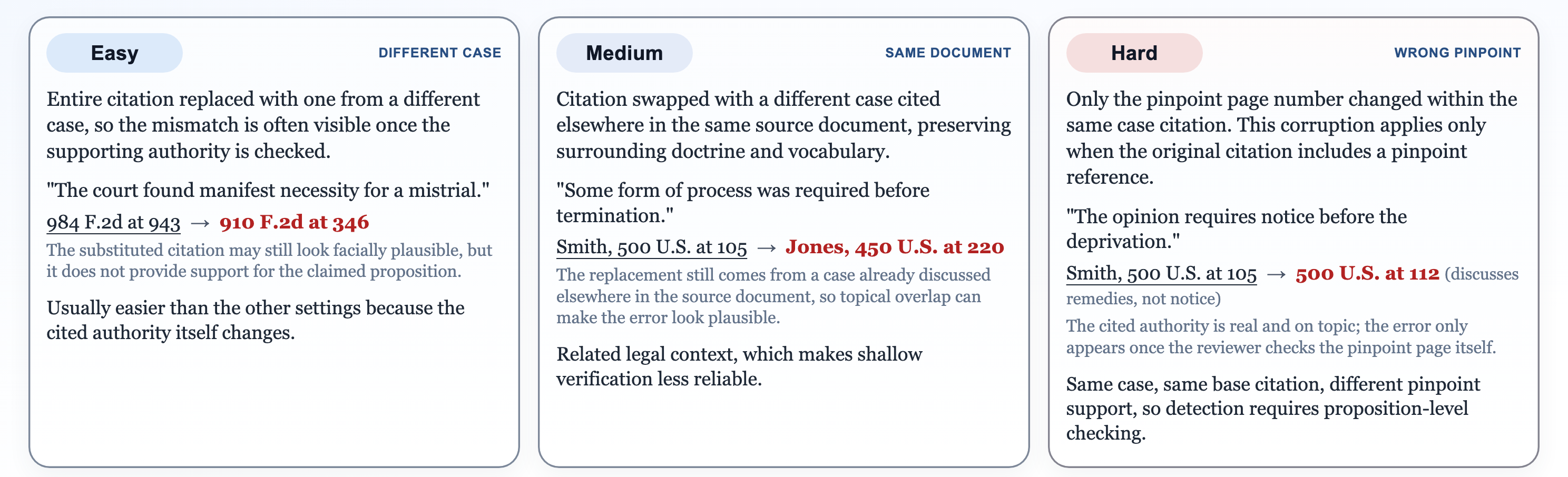
In the hard perturbations, only the page number is changed. To catch these errors, the model has to check the proposition against the cited page and cannot rely on shallow topical overlap.
What We Found
We evaluate fourteen frontier model configurations across three model providers – OpenAI, Anthropic, and Google. To keep this blogpost concise, we only discuss results on CLERC below, the court-opinion dataset. Results on BriefMe follow a similar trend and can be found in the main paper. Note that, the configurations we tested include prompting with and without reasoning. We did not test an agentic setup or a multi-turn interactive setup with a human in the loop. We also filter out any cases where data was missing due to API errors or other extraneous factors to isolate and study just the model’s ability to verify support under perfect data conditions.
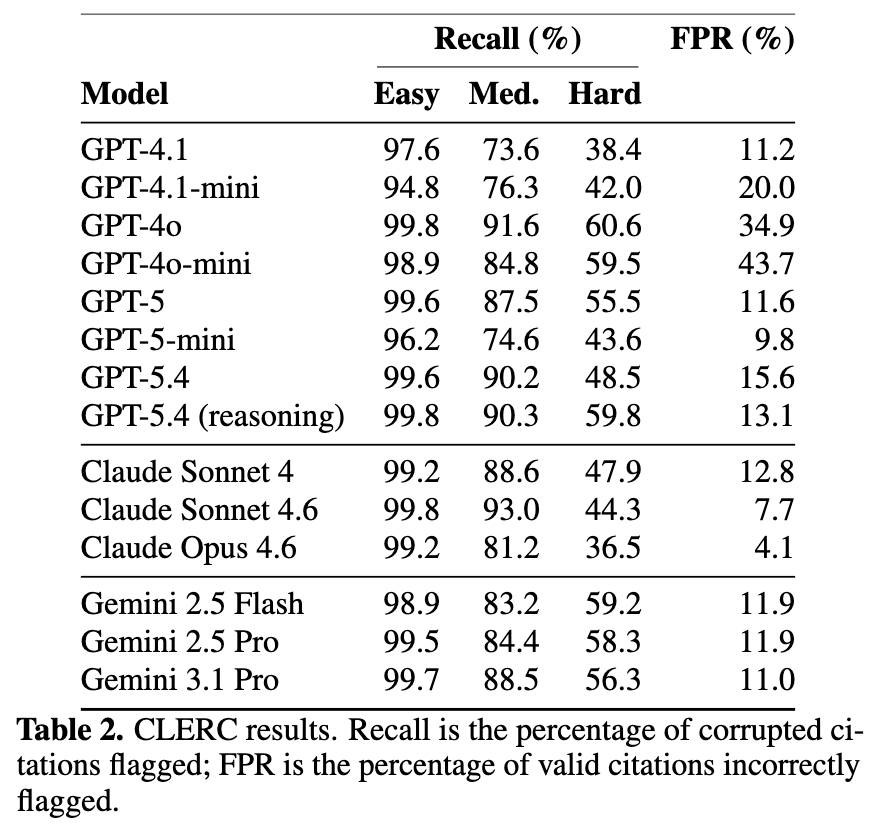
1. Models saturate on Easy but miss 37 to 61 percent of Hard cases
In the standard prompting regime, nearly every model saturates on the Easy corruptions. Recall is between 95 and 100 percent for all the models tested. Medium corruptions are a bit harder. But the recall on Hard corruptions falls to between 37 and 61 percent. No model achieves both a high recall on Hard examples and a low false positive rate simultaneously.
2. Reasoning and page-grounded prompting help, but the gap remains
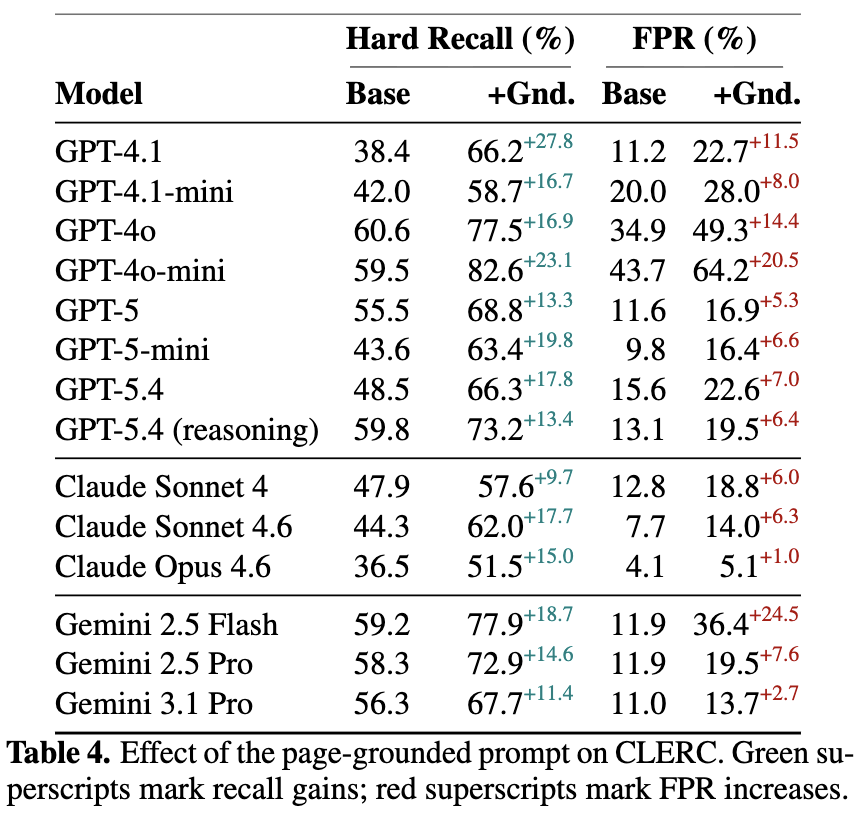
In the page-grounded prompting regime, GPT-5.4 with high reasoning effort improves recall on Hard examples. The page-grounded prompt tells the model to verify the cited page, check quoted text, and not accept topical relevance as support – or to put in other words, makes the prompt stricter. But the gain is not free. False positive rate also rises. The model is more sceptical overall. Selective scepticism is hard for models.
3. Models confuse topical overlap with propositional support
The topical overlap signal tends to dominate the propositional support signal, even when told to explicitly verify propositional support at the specific page.
We also emit a rationale along with on-pointedness decision which surfaces the model’s reasoning for its decision. In roughly two-thirds of the missed pinpoint errors, the model’s rationale says that the cited page “expressly states” or “explicitly says” something that is not present on that page. So the model is not merely accepting a bad citation – it is producing a confident explanation for why the bad citation is valid.
What This Means
Citation checking remains an unsolved and underexplored research problem. The results show that even the best models struggle to verify proposition-level support. In their evaluation, they often hallucinate rationales.
That said, this does not mean LLMs are useless for legal review. A tool that can triage easy cases and surface the hard ones for manual review could still save valuable human review time.
The project was made possible by the support of many people. I thank everyone from whom I learned through discussions. The appendix also contains experiments on distinguished and criticized citations that are worth a look. If you have questions, feel free to reach out.
Citation
If you find this work useful, please consider citing:
@inproceedings{verma2026citationonpoint,
  title     = {Is this Citation on Point?},
  author    = {Verma, Apurv},
  booktitle = {ICML 2026 Workshop on AI for Law (AI4Law)},
  year      = {2026},
  address   = {Seoul, Korea},
  url       = {https://arxiv.org/pdf/2608.12571}
}
-
The short version is that hallucination is more a feature than a bug. Since models are never rewarded for epistemic humility – i.e., saying “I don’t know” – and have little to lose from a confident wrong answer, they learn to mimic optimized test-takers who never leave a question blank, and so they hallucinate (See Kalai et al. (2025)). ↩
-
When we say all underlying elements of the citation are valid, we mean that the case exists, the citation metadata (volume, reporter, page) are correct, and the pinpoint page is within the opinion. The Bluebook is the standard legal citation style guide in the United States. ↩